| Maura Larkins v. CVESD |
| BLOGS |
| This document is from Maura Larkins v. Chula Vista Elementary School District |
| Public Records |
| Lawyer turns over his billing records--with descriptions of all his work blacked out Attorney's bills prompt review San Gabriel Valley Tribune, August 10, 2007 By Jennifer McLain ROSEMEAD The city attorney in May was paid more than four times the average monthly charge of the previous attorney, the latest billing records show. Bonifacio Garcia charged Rosemead $55,000, though information on what the money was spent for was redacted from records. He declined to give an itemized description of the charges, citing "attorney-client privilege." "I cannot go into detail," Garcia said. "It was $55,000 worth of work." The city attorney was hired in April after longtime City Attorney Peter Wallin and the firm Wallin, Kress, Reisman and Kranitz quit. According to the records, Garcia's law firm worked 222 hours in May, and charged between $210 and $225 per hour. Garcia also gets a $5,000 retainer. The invoice issued for May is the most recently paid. Invoices for June and July are not yet available. Garcia charged the city nearly $16,000 in April. During 2005-06, Wallin, Kress, Reisman and Kranitz charged $170,579, or $14,149 monthly, for their work as redevelopment agency and city attorney... City officials said they were surprised at the high charge for May. "I'm shocked that it's such a large amount," said Councilwoman Margaret Clark. "I plan to look into where the money is going." While Rosemead council members have access to the description of the 76 charges listed, Garcia redacted the information from the records the city released... "To not justify that cost to the taxpayers is patronizing," said Jim Ewert, general counsel for the California Newspaper Publishers Association... "There may be specific instances in the itemized description where there may be a greater public interest in maintaining the confidentiality of that information," Ewert said. "But it is hard for me to believe that every single item has that status." Interim City Manager Oliver Chi would only say that Garcia blocked out this information because it was privileged. "There is detailed information that the city is engaged with, and (Garcia) wanted to redact certain information so that nothing confidential would be made public," Chi said. Monterey Park's deputy city attorney, Adrian Guerra, said this is not an unusual practice. "Generally, that type of information is protected under the attorney-client privilege," Guerra said. [Maura's comment: Don't you mean to say that public entity lawyers frequently make this bogus claim? The public has a right to know how it's money is spent.] City officials would not comment on the redaction of the information... |
| Rosemead council delays decision on law firm San Gabriel Valley Tribune, July 19, 2007 By Jennifer McLain ...The search comes three months after the city hired Bonifacio "Bonny" Garcia as city attorney to represent Rosemead and its redevelopment agency. Garcia was brought on as lead attorney on the suggestion of Nunez. The council did not accept any other bids for the position. The council's decision in April drew some criticism from the community. Residents questioned Garcia's billing practices and why the council didn't put the contract out to bid... According to Garcia's resume, he "is an expert on the (Ralph M.) Brown Act, municipal governance, California conflict of interests and ethics laws binding on elected officials, litigation and labor and employment matters." |
| Brown Act "expert" causes problems with special meetings [Maura's Note: It seems that most lawyers who advertise themselves as "Brown Act experts" are actually offering the service of being able to help officials get away with Brown Act violations.] Town unhappy with report Wasco citizens pack council meeting on grand jury statement by Felix Doligosa, Jr., Californian staff writer WASCO -- Residents yelled "the city is unhappy" in a packed City Council meeting Tuesday night as discussion turned to a grand jury report that accuses council members and the mayor of having too many 'special meetings.' "It's been quite a rocky two weeks and it's getting to a point where we need a resolution," said Tilo Cortez Jr., vice mayor and council member for the city. A grand jury report stated that the council has "far too many 'special meetings'" that leave a perception the city does not want public input. On Jan. 24, the mayor, Danny Espitia, and one or two council members met to vote on the appointment of an assistant city manager, fire the city attorney and hire a new law firm, according to the grand jury report. The meeting was announced Jan. 23, according to the report. The grand jury report also said Councilman and former Mayor Fred West Jr. met with the former finance director to discuss his taking on the job as interim city manager. An unsigned contract showed up on the former director's desk, according to the grand jury. The grand jury report recommends that the City Council get additional training on the Ralph M. Brown Act. The state law allows very limited closed-door meetings concerning public business, according to the report. The report also recommended that Wasco residents get more involved in City Council meetings, the council stop having special meetings unless it is an emergency and that Espitia should stop voting until the city receives an opinion from the Attorney General of California. Espitia said he does not want to forward the report to the attorney general because there are lies in it. "The grand jury was misinformed," he said. "It's wrong. They never interviewed me." The grand jury said in the report that it interviewed the mayor. When Cortez asked if the report was telling the truth, Espitia replied, "So we can agree the grand jury can make another mistake." Dozens of citizens filled the seats and some stood in the aisles as they argued with council members. "This is just not right," said Wasco resident Susana Rios... Garcia has made about $83,000 in four months as the city attorney, said Councilwoman Cherylee Wegman. The grand jury report said Garcia makes about four to five times more than the previous attorney. Garcia said he would be happy to have an evaluation of his work another time. "We have to talk about what's on the agenda," said Wegman who tried to direct discussion toward the grand jury report. "It's the law." After hearing pleas from the audience, the City Council voted to postpone discussion of the alleged Brown Act violations and the hiring of Garcia until a public meeting on July 3. Bakersfield California, June 20, 2007 Link |
| "According to Bonny Garcia's resume, he 'is an expert on the (Ralph M.) Brown Act, municipal governance, California conflict of interests and ethics laws binding on elected officials, litigation and labor and employment matters.'" |
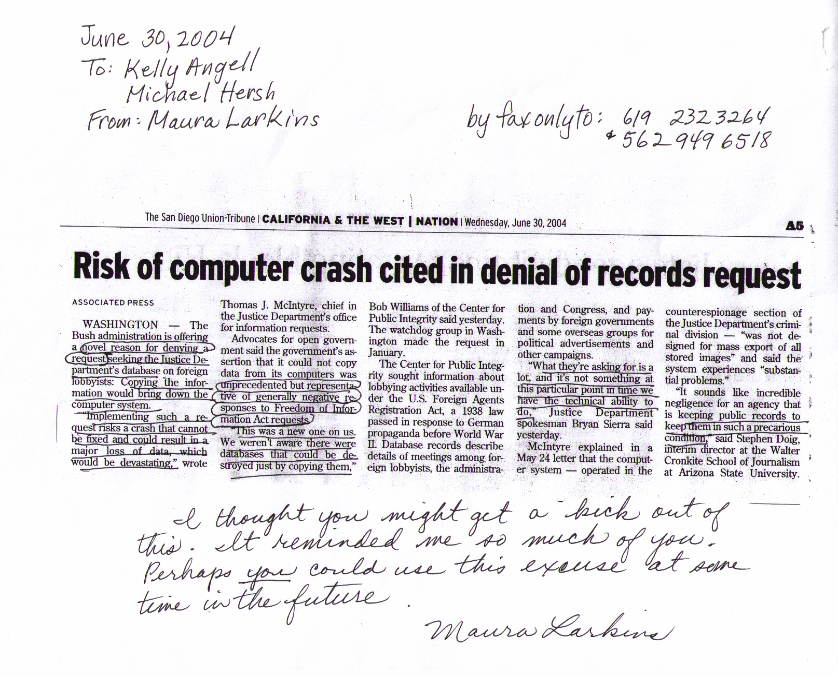
| Many public entities in California are fond of operating in secret. This puts them in direct opposition to the California Public Records Act and the Ralph Brown Act. |
| San Diego County Office of Education and Chula Vista Elementary School District refuse to release invoices SDCOE-JPA released the least important invoices for Daniel Shinoff's work on the Maura Larkins v. CVESD case. |
| This timeline shows the invoices that SDCOE refuses to release: Larkins case timeline. |
| Schools keep lots of secrets, but expose student information Voice of San Diego EMILY ALPERT February 6, 2009 ...This is a little story that illustrates a bigger problem: How well schools protect information about their students. I heard about this one from parent Sally Smith, who feels that the practice of having Spanish classes specifically for Spanish speakers is discriminatory and segregates them into a separate class instead of putting them into a more advanced class. So she complained to the school district about the issue. But the response to her complaint ended up annoying her just as much -- maybe more -- and not just because San Diego Unified wrote back arguing that her complaint was unfounded and no discrimination had occurred. To back up its points that students had been correctly placed in their classes, San Diego Unified included some e-mails between Spanish teachers that revealed how individual students had scored on Spanish placement tests and which of them had failed their last English class. The e-mails included their full names. Oops. Revealing student information like that is a major no-no under the law. Smith was upset. And the information was released in November -- just after San Diego Unified had done an internal report that certified that student information was well protected and employees understood the rules. I called up Jose Gonzales, deputy general counsel for the school district and the guy who signed off on the complaint, to ask what happened. He agreed that student records -- including test scores and grades -- are not supposed to be released to outsiders. Even to make a point. "It was a mistake. That's all there is to it," Gonzales said. Feel free to tell me about problems -- big, small and in between -- and triumphs in your school. You can send me an e-mail at emily. alpert@voiceofsandiego. org. |
Education Reform Report
